
What is Risk Management in Trading?
Learn why risk management matters more than picking winners. Master the 1-2% rule, stop-losses, and tools to protect your trading capital.
The vast majority of traders – some 90% [1] - lose money within their first year. But it's not because they can't pick winning trades or that they lack market knowledge. It’s because they never learned the fundamentals of risk management.
Incorporating robust risk management guardrails into your trading approach will inevitably be a lifelong pursuit because risk is multi-dimensional and ever-changing. You should always be aware of how much risk you are taking on in your trading portfolio by systematically identifying, assessing, and controlling potential losses. Think of it as your financial safety net. It keeps you in the game when trades go wrong, which they inevitably will.
Many beginners fall into the trap of expecting to make profits without seriously planning how to manage their losses. They concentrate entirely on when to enter the market and how much they hope to gain but pay little attention to how they should react if the market moves against them. Investing without considering the risk is like driving without insurance: accidents don’t happen every day, but when they do, it can be very costly if you haven’t prepared a cushion to absorb the financial impact.
In this guide, you'll learn why managing risk is more important than just picking winners. You'll also explore the specific challenges of online trading and become familiar with the tools and techniques that separate the successful from the unsuccessful traders. Keep in mind, this isn't about eliminating risk completely; successful trading involves smart risk-taking, not careless gambling.
What is Risk Management? Understanding the Foundation of Successful Trading
What is risk management? In simple terms, risk management is your trading insurance policy. It's a system designed to protect your trading capital while allowing you to take advantage of market opportunities that open up.
At its heart, risk management addresses the basic psychology behind why traders don’t consider and plan for losses. Many people are naturally optimistic about their trades, believing each position will be profitable. While this optimism is crucial when navigating uncertain markets, it becomes problematic when it stops you from properly preparing for the inevitable negative outcomes that will come your way as a trader.
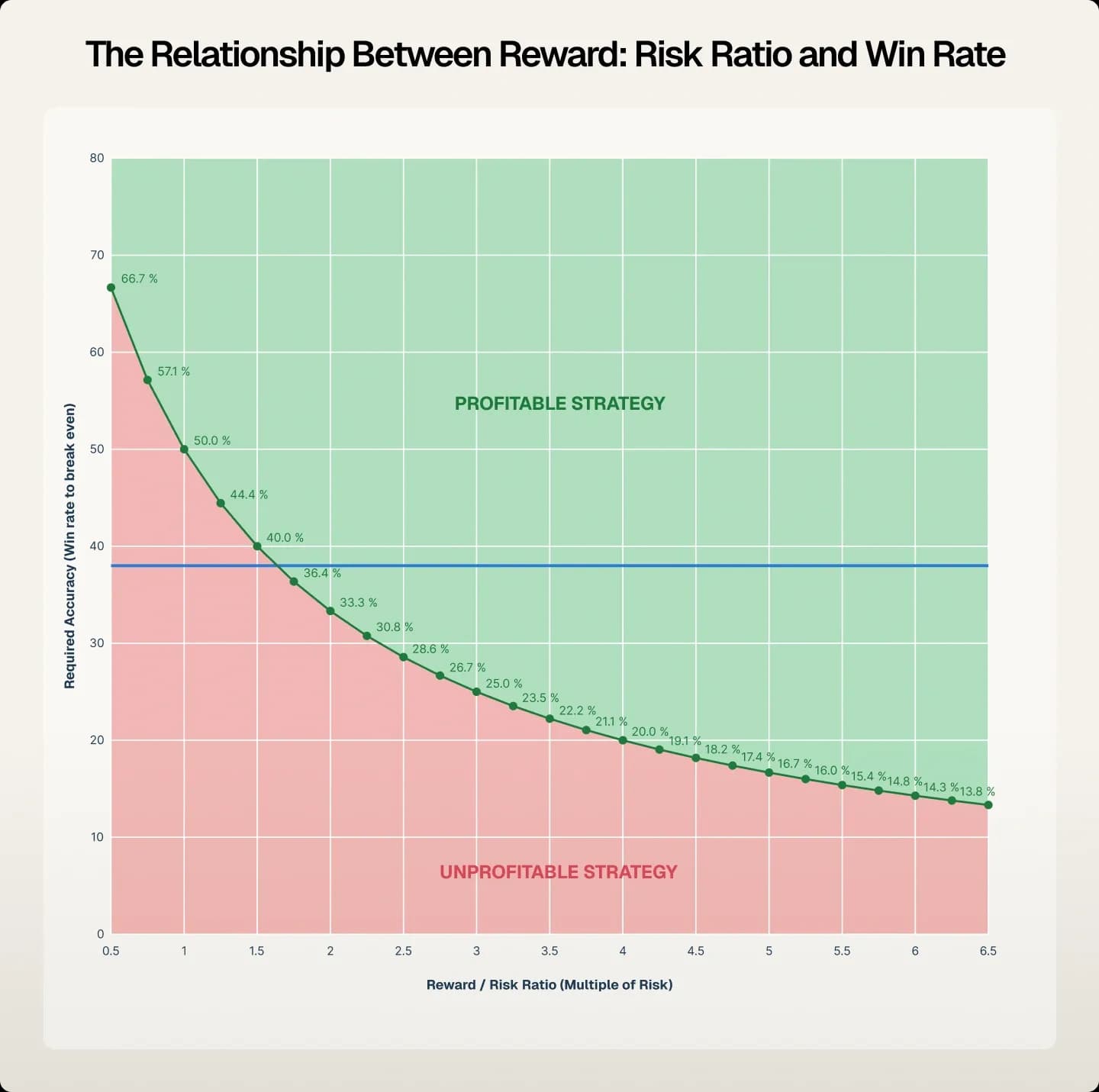
The numbers show how managing risk is mathematically proven to be more important than picking winners. A trader with a 40% win rate, which is the number of profitable trades they make as a percentage of all their trades over a defined period, can still make money with proper risk management, while a trader with a 70% win rate can lose everything without it [2].
Here's the basic principle that every trader should understand: You can be wrong 60% of the time and still be profitable if you manage your risk properly. This happens when your average winning trade is larger than your average losing trade, combined with strict position sizing rules.
The following graph highlights the relationship between risk, reward, and win rate, showing where your trading strategy is statistically likely to be profitable or unprofitable.
Professional traders know that generating consistent returns arises from managing their losses, and not from being right all the time. History has shown that the foundation of effective trading rests on four key pillars: capital preservation, which keeps your money safe; emotional control, which helps you make rational decisions; consistency, which involves repeating processes that the evidence shows are working; and longevity, which means staying in the game long enough to multiply your gains.
Types of Risks Every Online Trader Must Know
To build a resilient risk management foundation that will help you manage losses and maximise profits through good and bad times, you need to first understand the different types of risks you face. The nature of online trading means you will face different challenges than those typically faced in traditional trading. Understanding these will help you learn how to quantify and prepare for these risks.
Market Risk
Market risks are the economic and geopolitical risks that arise due to changing market conditions, such as specific events, news stories, and shifts in investment sentiment. These are often surprising and make it more difficult to anticipate the future direction of prices. Market risk is the most obvious risk you will need to manage by ensuring your position sizing is appropriate for the conditions and that you placing stop-loss orders to reflect them.
Psychological Risk
This risk is arguably the most difficult to manage because you need to recognise your blind spots and manage your emotions so that you can make rational decisions. The most common emotions that trip up traders are fear and greed. Fear and greed can make you sell at the bottom of the market when prices are at their lowest and buy at the top when prices are at their highest. It can also cause you to engage in revenge trading, make a trade based on the Fear of Missing Out (FOMO) or hold positions too long because you live in hope of them recovering.
Leverage Risk
Leveraging your trades allows you to take much bigger positions than your capital allows. Tempting as it is, leverage is a double-edged sword because it amplifies the downside risk of a trade as well as the upside, putting you at risk of multiplying your losses during an unanticipated market sell-off.
Liquidity Risk
Liquidity conditions can vary significantly across the forex market depending on the currency pair. Minor and, particularly, exotic currency pairs are far less liquid than the major currency pairs, like the EUR/USD, USD/JPY, and GBP/USD. That means there are not as many buyers and sellers trading in these currencies, and you risk not being able to exit your trading position at a fair price, especially when market conditions have deteriorated and bid-ask spreads have widened.
Platform Risk
Online trading platform risks arise when your broker experiences technical failures, execution delays, and connectivity issues, which result in losses in your trading portfolio. Unlike traditional brokers, online platforms are heavily dependent on technology, raising platform risks.
These online trading risks differ significantly from traditional investing risks because of the speed, leverage, and technology dependence inherent in modern trading platforms.
The 1-2% Rule: Your First Line of Defence
The 1-2% rule is arguably the most important risk management tool in your toolkit. This rule states that you should never risk more than 1-2% of your total trading capital on any single trade.
Here's why this rule is so important for beginners: If you risk 2% per trade, you can withstand 50 consecutive losses before depleting your account. Even with a low 30% win rate, the probability of 50 consecutive losses if you follow the 1-2% rule is virtually zero.
Let's look at a mathematical example. Suppose you have a £5,000 trading account and follow the 2% rule. Your maximum risk per trade would be £100. If you buy shares at £50 each and set your stop-loss at £48, you're risking £2 per share. Dividing your maximum risk (£100) by your risk per share (£2) gives you a position size of 50 shares.
Position sizing calculations become straightforward once you understand this relationship: Position Size = Total Risk Amount ÷ Risk Per Share. This formula ensures you never surpass your predetermined risk tolerance, regardless of the stock price or stop-loss distance you set.
The most common mistake beginners make is confusing position size with the risk they are taking on. You might think, "I can afford to buy 100 shares," without calculating how much you could actually lose ($200 versus $100, all else being equal) if the trade goes against you.
Essential Risk Management Tools for Online Traders
The advantages of online trading are that specialised risk management tools are readily available to you. These enable you to automate and systematise your trading process and put in place controls that minimise your losses. These tools eliminate emotions from your decision-making and help you adhere to your chosen trading strategy.
Stop-Loss Orders
A stop-loss order is an automatic instruction to sell an asset in your trading portfolio when its value reaches a specified level. It acts as a vital risk management tool designed to limit your losses without requiring constant monitoring of your position or making difficult emotional decisions to sell.
Take-Profit Orders
Take-profit orders are the opposite of stop-loss orders. They allow you to lock in gains before the market shifts and eats into your profits. They also prevent your emotions from interfering, such as giving in to greed and holding winning positions for too long. Again, the order is also triggered automatically, which means you don’t need to continually watch the market.
Risk-Reward Ratios
A risk-reward ratio is the ratio of potential profits to losses you are willing to take, and it helps you decide whether you are comfortable with making the trade. A 2:1 ratio is the minimum that professional traders broadly aim for because they stand to make twice as much profit as they are willing to lose. The math shows that traders implementing a trade based on a 2:1 risk-reward ratio can make profits even if they only have a 40% win rate, as indicated in the above graph.
Position Size Calculators
Many online platforms include built-in position size calculators, which automatically calculate the number of shares or contracts to trade based on a combination of factors, such as your account size, risk tolerance and the stop-loss distance you have implemented.
Most online trading platforms allow you to set these orders simultaneously when entering a position. However, they can fail during extreme market volatility. Therefore, it’s essential to have backup plans and never rely solely on automated instructions you have put in place.
The Psychology of Risk Management: Controlling Your Biggest Enemy, Emotions
Emotions represent the biggest online trading risks because they drive irrational decision-making. Fear can prompt traders to exit winning positions too early or not make trades that offer great potential. Greed can lead to over-leveraging, moving or removing stop-losses, or holding losing positions in the hope of them recovering.
FOMO and revenge trading are particularly destructive emotional trading behaviours. FOMO drives traders to chase prices and enter positions at poor levels, while revenge trading results in traders increasing position sizes after making losses in an attempt to "get even" with the market.
By creating automatically implemented trading guardrails, you can remove emotions from critical decisions. These rules should specify exactly when you'll enter trades, where you'll place stop-losses, and when you'll take profits by exiting the position. The more systematic your approach, the less likely you are to make detrimental emotional decisions.
Accepting losses is an inevitable part of your trading journey and a key determinant of your long-term performance outcomes. Professional traders recognise that losses are simply the cost of doing business, much like the rent or utilities a business has to pay.
If you lose, say, 3% of your account in a single day, stop trading and analyse what went wrong. Journaling also promotes self-awareness and helps you identify patterns of behaviour and your blind spots when you are both winning and losing money.
Common Risk Management Mistakes That Destroy Trading Accounts
Moving stop-losses when trades go against you is perhaps the most destructive mistake traders make. This turns small, manageable losses into account-threatening disasters.
Risking too much on "sure thing" trades violates the fundamental principle that no trade is guaranteed. The market doesn't care about your analysis or conviction; - it will do what it wants regardless of your expectations.
Not having a trading plan before entering positions leaves you vulnerable to emotional decision-making when money is at risk. Every trade should have predetermined entry, exit, and stop-loss levels before you risk any capital.
Ignoring the correlation between multiple trades can result in concentrated risk. Holding multiple positions in the same sector or highly correlated assets effectively increases your risk per trade beyond your intended limits.
Trading without understanding your platform's execution characteristics can lead to unexpected slippage, delays, or failed orders at critical times.
Building Your Personal Risk Management Strategy
- Create a pre-trade checklist that ensures consistency in your risk management approach. Your checklist should include verifying your account balance, calculating your position size, placing stop-loss limits, and confirming you are comfortable with your risk-reward ratio.
- Set up your trading environment so you can trade in accordance with your risk management strategy. That includes having all the necessary tools readily available and removing distractions that could result in poor decision-making.
- Choose the right position sizes for your account by realistically assessing your risk tolerance and trading experience. New traders are well-advised to begin with smaller position sizes until they achieve consistent profits.
- Adjust your risk based on performance to improve your strategy over time. To protect your capital, gradually increase position sizes during profitable periods and reduce them during losses.
- Regularly review and adjust your strategy to ensure your risk management approach adapts to market conditions and your growing skills.
Conclusion
Risk management is the foundation of profitable trading, far more crucial than the ability to select winning trades. The mathematics of trading shows that protecting your capital is more important than making profits because you can't make money if you don't have money to trade.
Professional traders understand that successful risk management isn't about avoiding risk entirely; it's about taking calculated risks while safeguarding your capital against catastrophic losses. The techniques outlined in this guide offer a systematic approach to staying in the game long enough to develop profitable trading skills.
Before placing your next trade, follow these risk management principles, starting with the 1-2% rule. Remember, every professional trader was once a beginner, but only those who learned to control risk effectively have survived long enough to become consistently profitable. Your future trading performance relies on the foundation you establish today.
Frequently Asked Questions
[1] Journal of Advanced Research in Accounting and Finance Management, Volume 6, Issue 1 – 2024, “Why 90% of Stock Market Traders are in Loss?”.
[2] LuxAlgo, February 24, 2025, “Win Rate and Risk-reward: Connection Explained”, Christopher Downie .
Trading guides have been prepared by INGOT SC Ltd., for educational purposes only. This information is general in nature and should not be considered as personal recommendations.
Trading guides does not constitute personal advice and does not take into account your objectives, financial situation, or needs. You should carefully consider whether trading complex leveraged products, such as Contracts for Difference (CFDs), is appropriate for you given your circumstances.
CFDs are complex, leveraged products that carry a high risk of loss. The majority of retail investor accounts lose money when trading CFDs. You should ensure you understand how CFDs work and assess whether you can afford to take the high risk of losing your funds. If you are uncertain whether these products are suitable for you, consider obtaining independent financial advice before trading.
Any examples, patterns, or strategies discussed in this guide are based on historical data and market theory. Past performance is not a reliable indicator of future results. Market conditions can change rapidly, and technical patterns may fail without warning.

Learn how to trade Doji candlesticks: the three types, their success rates, and how to confirm reversals with volume and proper risk management.
Read more
Learn how to read forex trading charts including line, bar, and candlestick types, OHLC data, timeframes, and support/resistance levels.
Read more
Risk management in trading protects your capital. Learn the 1-2% rule, stop-losses, and position sizing to limit losses and trade profitably.
Read more